
Typography has shaped how we read and interpret the world for centuries, long before it became a formal design discipline. From early written forms to today’s digital interfaces, it has quietly influenced how meaning is constructed and perceived. We rarely stop to question why a brand feels trustworthy or authoritative at first glance, yet before we engage with language or intent, typography is already doing the heavy lifting, shaping perception through visual forms learned over time.
In branding, typography plays a key role in defining a brand’s tone of voice. It reflects values and stirs specific emotions. When used consistently, it strengthens recognition, allowing audiences to grasp a brand’s personality in seconds. Beyond aesthetics, typographic choices function as a strategic design tool, capable of triggering specific emotional responses. To understand why certain typefaces resonate the way they do, it becomes essential to look at their historical roots and the associations those origins continue to carry today.
A (Very) Brief History of Typography
Our culture and history shape the subconscious signals we pick up from design choices: why something feels classy, modern, or bold is often less about conscious thought and more about an intuitive gut reaction.
In typography, that reaction is often linked to how a typeface category emerged and the historical context behind it. The story of type is nearly as old as human civilization itself, so summarizing it fully is no small task. For time’s sake, we’ll start where mechanical reproduction and standardization became possible: the invention of the printing press.
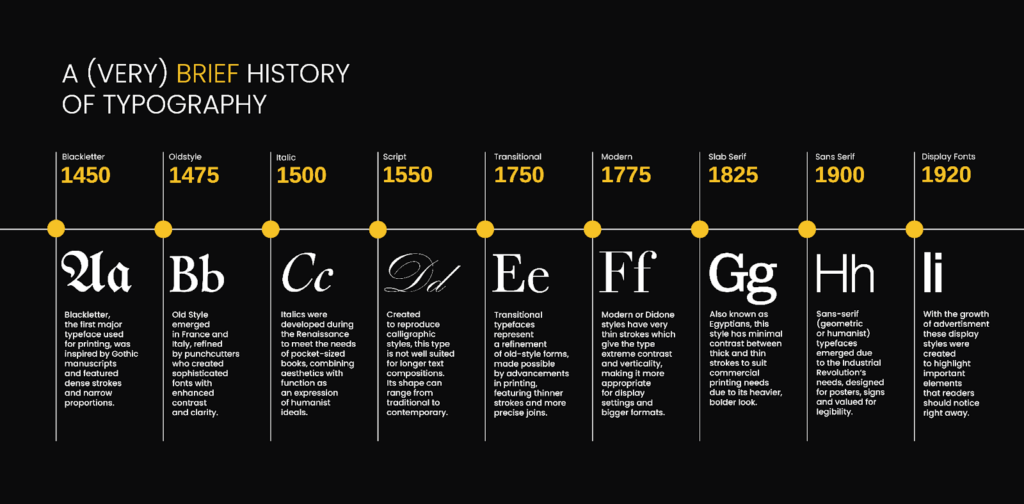
- Blackletter (1450)
Blackletter, the first major typeface used for printing, was inspired by Gothic manuscripts and featured dense strokes and narrow proportions. - Old Style (1475)
Old Style typography emerged in France and Italy in the late 15th century, refined by punchcutters who created sophisticated fonts with enhanced contrast and clarity. - Italic (1500)
Italics were invented during the Renaissance to meet the necessities of pocket books and they combined aesthetic with function as a reflex of the renaissance period. - Script (1550)
Created to reproduce calligraphic styles, this type is not well-suited for longer text compositions. Its shape can range from traditional to contemporary. - Transitional (1750)
Transitioning is a perfecting of the old style shapes, made possible by advancements in printing, with thin lines and refined joints. - Modern (1775)
Modern or Didone styles have very thin strokes, which give the style extreme contrast and verticality, making them more appropriate for display settings and bigger formats. - Slab Serif (1825)
Also known as Egyptians, this style has minimal contrast between thick and thin strokes to suit commercial printing needs due to its heavier, bolder look. - Sans Serif (1900)
Sans-serif typefaces emerged due to the Industrial Revolution‘s needs, designed for posters and signage and valued for legible forms. - Display Fonts (1920)
As advertising grew these styles were created to highlight important elements that readers should notice right away.
It’s clear that the industrial revolution and its ever-increasing demands served as a major driving force behind the diversification of typefaces. As branding grew as a discipline and practice, so did the need to communicate faster and to stand out among a sea of competing messages. This era sparked a creative boom in typography, giving rise to many typefaces that are still highly relevant to this day. Realizing the nuances between each make it easier to understand why, for example, serif typefaces convey traditions or sophistication while sans-serif type point us towards modernity and simplicity.
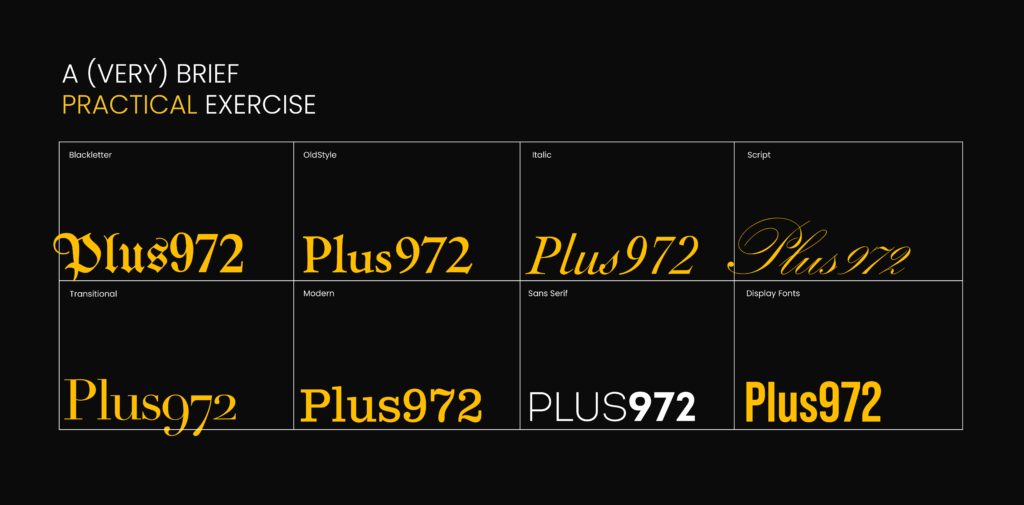
To make this more tangible, we’ve reimagined our logo in several of the styles discussed above. Seeing them side by side highlights how dramatically mood can shift, serving as a practical example of how typography alone can shape a brand’s overall look and feel.
Turning History Into a Creative Tool
Understanding the historical weight behind typographic choices provides past context that can be applied today. It helps us anticipate how audiences will read and remember a brand. In practical terms, this knowledge empowers brands to communicate with precision in order to build a recognisable identity that stands out from competitors. Studying typographic history isn’t about nostalgia; it’s about elevating the quality and clarity of contemporary design.
Typography remains a silent foundation that is often overlooked, yet it functions as a building block for almost every other tool a brand can use to communicate. Its influence may be subtle, but its impact is decisive: it shapes perception long before the message is read.
At Plus972, we don’t see typography as a decorative detail; we approach it as an integral part of the design process. Every choice we make for a client, from loud display fonts to the quiet body copy, draws on an understanding of how history and form shape brand perception. By considering the historical weight behind typefaces, we ensure that the brands we build and scale are not only visually striking but also compelling communicators, voicing clarity and impact. Our goal is to harness this soft power to craft identities that connect, resonate, and grow your business.