
If you’ve opened Google lately and seen an AI Overview push the “normal” results down the page, or had a prospect say “I found you through ChatGPT”, then you’ve felt it already:
How people discover and shortlist partners is shifting into AI assistants.
We don’t think that’s a fad. And we’re not writing this as “AEO masters,” but as a boutique agency that’s taking this seriously for our own marketing and for the brands we work with.
We’re still early in our journey, but here’s what we’re seeing.
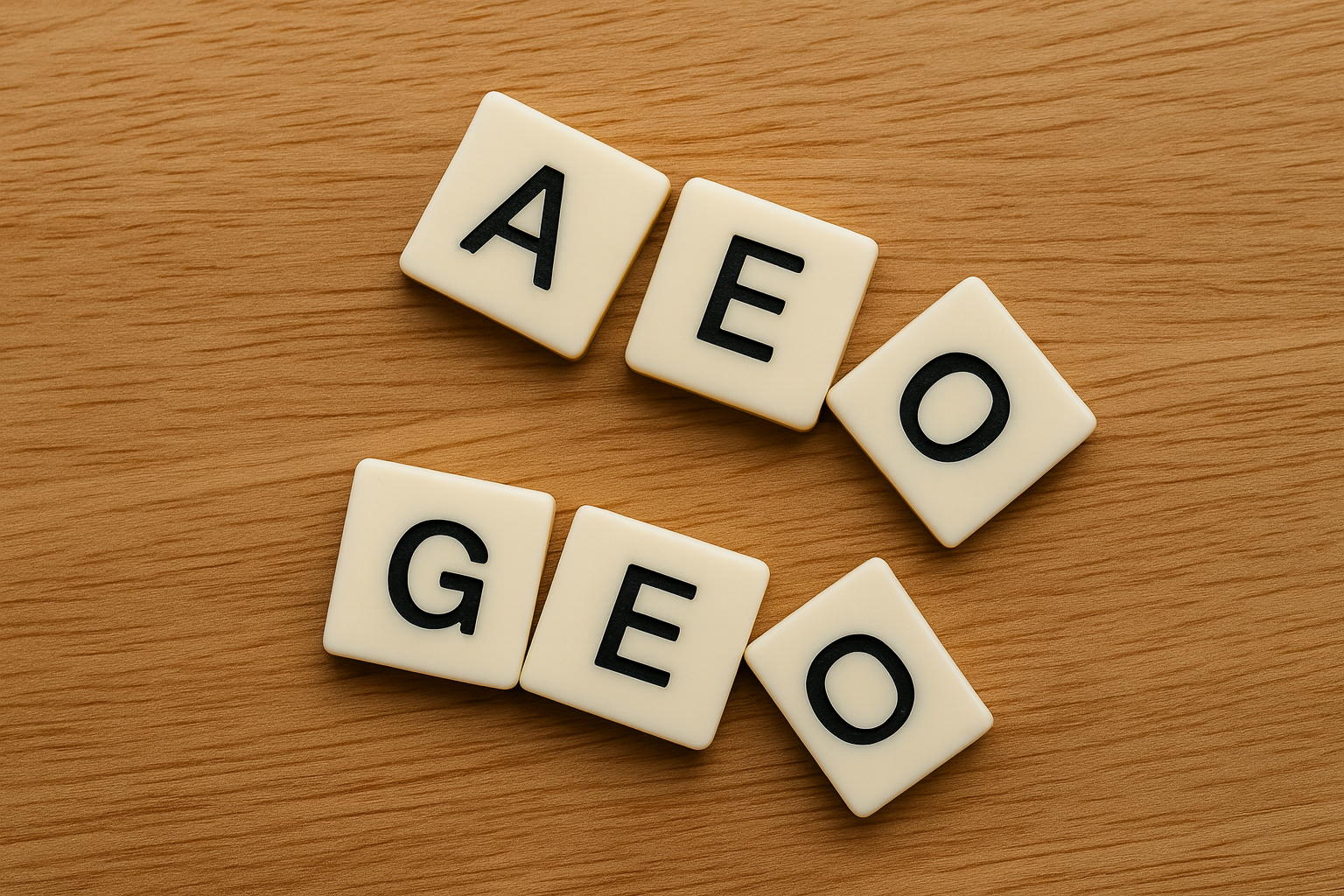
Quick answer: AEO/GEO (Answer Engine Optimization / Generative Engine Optimization) is the practice of making your brand easy for AI assistants—like Google’s AI Overviews, ChatGPT, and Gemini—to understand, trust, and reuse in their answers. It doesn’t replace SEO, but it’s becoming a critical layer for lead generation and customer acquisition.
What we mean by AEO & GEO
There are a lot of acronyms flying around, so let’s simplify:
- Answer Engine Optimization (AEO) – making your content answer-friendly: clear, structured, and written in the same language people use when they ask questions.
- Generative Engine Optimization (GEO) – helping generative systems (AI Overviews, ChatGPT, Gemini, Perplexity, etc.) understand who you are, what you do, and when to confidently bring you into the conversation.
In practice, both are about one thing:
When a buyer asks an AI assistant a question in your space, do you show up in the answer, the shortlist, or the follow-up suggestions?
That’s the new “position one.”
Why this is more than a fad
We see three reasons this shift isn’t going away:
1. Buyers are already using AI as a research layer
People are quietly using AI to:
- Translate messy internal questions into something search-ready
- Summarize options before they click anything
- Validate shortlists they built from other channels
Even if the final click is still an organic, paid, or referral visit, AI is shaping who makes the shortlist.
2. Platforms are doubling down on generative answers
Google, OpenAI, and others are investing heavily in AI-native experiences. That means:
- More questions will be answered inside AI interfaces
- More decisions will be influenced before anyone gets to your website
If your brand doesn’t exist clearly in the data these models lean on, you’re invisible in that layer of the funnel.
3. The incentives line up
Platforms want answers that are:
- Accurate
- Fast
- Easy for users to understand
That naturally favors brands with:
- Clear, consistent facts
- Answer-style content
- Solid authority signals (profiles, reviews, mentions)
That’s what AEO/GEO is about.
How AEO/GEO actually works (at a high level)
We’re simplifying here on purpose, but most of what we’ve seen so far boils down to four ingredients:
Entity clarity
AI systems need to know who you are:
- Your brand name
- Where you’re based
- What you offer
- Who you serve
If those facts aren’t consistent across your site and profiles, it’s harder for models to confidently talk about you.
Structured information
Things like Schema.org (Organization, FAQ, etc.) and clearly marked headings make it easier for systems to “parse” your content and treat it as a reliable building block.
Answer-style content
Content that:
- Starts with a direct answer
- Uses question-style headings (“What is…”, “How do you…”, “Best…”)
- Breaks things into simple steps and comparisons
This is the kind of copy that’s easy to quote.
External trust signals
Profiles (LinkedIn, Crunchbase, Clutch, etc.), reviews, and PR mentions are often used as reference points. If you look credible in those places, AI assistants are more comfortable bringing you into the conversation.
How AEO/GEO overlaps with SEO (and how it doesn’t)
We’ve done SEO and growth work for years. AEO/GEO touches a lot of familiar ground, but the target looks different.
Where they overlap
Technical hygiene
Fast, crawlable pages, clean architecture, and structured data matter in both worlds.
Helpful, relevant content
You still need content that actually answers real questions, not just keyword-stuffed pages.
Topical and brand authority
Search engines and AI models both lean on clear signals that you know what you’re talking about and that others vouch for you.
Where they differ
The “position” you’re fighting for
- SEO: rankings on a results page
- AEO/GEO: inclusion in an answer or shortlist
How people interact with your content
- SEO: users click and choose what to read
- AEO/GEO: the system may quote your content without the user ever seeing the full page
How you measure impact
- SEO: impressions, clicks, rankings, organic sessions
- AEO/GEO: mentions in AI answers, citations, and the downstream traffic and leads that come from those surfaces
Where optimization happens
- SEO is still heavily Google-centric
- AEO/GEO spans multiple “engines”: AI Overviews, ChatGPT, Gemini, Perplexity and more
You don’t abandon SEO for AEO/GEO. You extend your SEO thinking into a world where answers are assembled rather than just ranked.
What we’re doing at Plus972
We’re not writing this from a “we’ve cracked it” posture.
Internally, we’ve:
- Started mapping the questions our ideal clients ask AI tools when they’re trying to understand agencies like ours.
- Looked at where we already show up (and where we don’t) when we test those prompts.
- Begun reshaping certain pages, especially explainer and FAQ-style content, to be more answer-friendly.
- Updated some of our structured data and profiles so our basic facts are clearer and more consistent.
We’re treating this like an ongoing experiment:
- Test prompts
- See how (or if) we appear
- Adjust what we control (content, structure, profiles)
- See what changes, and repeat
And we’re building this into our offering gradually, starting with clients who are also curious and want to learn alongside us.
A few early takeaways on “doing it right”
We’re still learning, but a few patterns are already clear.
1. Clarity beats cleverness
The more straightforward you are about:
- Who you are
- Where you operate
- What you actually do
- Who you do it for
…the more likely AI systems are to pull you in. Overly clever copywriting can be fun for humans but confusing for machines.
2. Write like someone is asking you a question
Pages that perform better in our tests usually:
- Start with a short, direct answer
- Use question-style headings
- Break complex topics into simple, ordered steps
If a human could copy/paste your answer into Slack and say “Here’s the gist,” you’re on the right track.
3. Consistency across the web matters
If your:
- LinkedIn says one thing
- Website says another
- Directories and profiles say something else
…it’s harder for AI models to know which version of you is “true.” Tightening up this basic entity hygiene seems boring, but it makes a difference.
4. It’s not a one-off project
Like SEO, this isn’t a “set it and forget it” checklist.
Models evolve. Platforms add new surfaces. Your own services and positioning change.
We’re approaching AEO/GEO as a cycle:
Observe → Adjust → Publish → See what changed → Repeat
If you’re wrestling with this too
If you’re also looking at AI Overviews, ChatGPT answers, and Gemini responses wondering “How do we make sure we’re part of this?,” you’re not alone. That’s exactly the question we’re asking for ourselves and for our clients.
If you’d like to compare notes, sanity-check where you are, or explore how this might plug into your broader SEO and growth plans, don’t hesitate to reach out!
Talk to a boutique team across NYC & Lisbon → Contact
FAQ JSON-LD
<script type=”application/ld+json”>
{
“@context”: “https://schema.org”,
“@type”: “FAQPage”,
“mainEntity”: [
{
“@type”: “Question”,
“name”: “What are AEO and GEO?”,
“acceptedAnswer”: {
“@type”: “Answer”,
“text”: “Answer Engine Optimization (AEO) and Generative Engine Optimization (GEO) focus on making your brand easy for AI assistants and generative systems—such as Google AI Overviews, ChatGPT, and Gemini—to understand, trust, and reuse in their answers and shortlists.”
}
},
{
“@type”: “Question”,
“name”: “How are AEO and GEO different from SEO?”,
“acceptedAnswer”: {
“@type”: “Answer”,
“text”: “SEO focuses on ranking in traditional search results, while AEO and GEO focus on being included in AI-generated answers and recommendations. They share foundations like clear content, technical hygiene, and authority, but AEO and GEO place more emphasis on answer-style content, consistent brand facts, and visibility across multiple AI assistants.”
}
},
{
“@type”: “Question”,
“name”: “Is AEO or GEO just a fad?”,
“acceptedAnswer”: {
“@type”: “Answer”,
“text”: “The rise of AI assistants in everyday research and buying decisions suggests that appearing in AI-generated answers will remain important. As search products increasingly incorporate AI summaries and conversational interfaces, optimizing how your brand is understood and reused by these systems is likely to become a core part of lead generation and customer acquisition.”
}
}
]
}
</script>